Architecture Overview
Scoriet is a sophisticated enterprise SaaS platform built with a modern full-stack architecture. This document provides a high-level view of how all components work together.
System Architecture Diagram
Core Architecture Principles
1. Monolithic with Separation of Concerns
Scoriet uses a monolithic architecture pattern that combines Laravel and React:
- Single Codebase: Backend and frontend code live in the same repository
- Inertia.js Bridge: Seamlessly passes data from Laravel to React without API serialization
- Clear Boundaries: Each layer has distinct responsibilities and minimal coupling
2. Multi-Document Interface (MDI)
The frontend uses rc-dock to provide a professional MDI workspace:
- 57 Lazy-Loaded Panels: Each panel is loaded on-demand using React.lazy()
- Floating & Docking: Panels can be arranged as floating windows or docked to workspace edges
- Persistent Layout: Workspace arrangement is saved and restored between sessions
- Hotkey Navigation: Alt+key combinations for rapid access to common operations
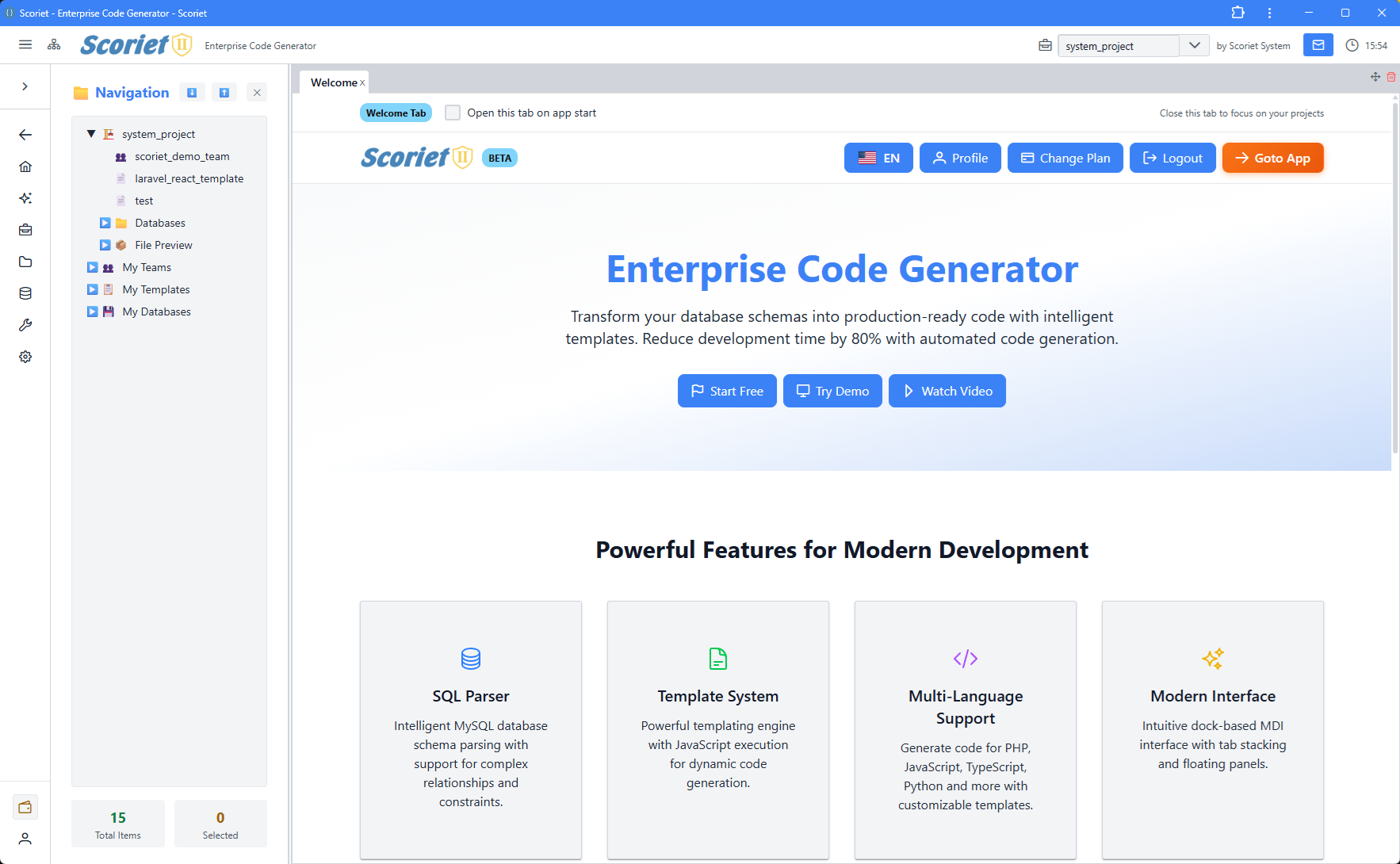 The MDI (Multi-Document Interface) with navigation tree, dock panels, and tabbed content area
3. OAuth2 Authentication
Security is implemented through a robust OAuth2 flow:
- Laravel Passport: Manages OAuth2 token lifecycle
- Password Grant Flow: Desktop-style authentication for Scoriet users
- JWT Tokens: Stored in localStorage with automatic refresh
- API Protection: All
/api/*routes require Bearer token authentication
4. Real-Time Communication
WebSocket support via Laravel Reverb enables:
- Live Notifications: Instant updates across all user sessions
- Team Messaging: Real-time chat and collaboration features
- Broadcast Events: Changes sync across all connected clients
- Presence Awareness: See who else is online and active
Request Flow
Typical API Request Cycle
Authentication Flow
Component Hierarchy
Backend Components
app/
├── Http/
│   ├── Controllers/
│   │   ├── Auth/              # Authentication endpoints
│   │   ├── Api/               # Main API controllers
│   │   ├── Admin/             # Admin panel operations
│   │   ├── Settings/          # User settings
│   │   ├── Cli/               # Command-line operations
│   │   └── Traits/            # Reusable controller logic
│   └── Middleware/            # Auth, CORS, etc.
├── Services/
│   ├── MySQLParser.php        # Database schema parsing
│   ├── CodeGeneratorService.php
│   ├── TemplateEngineService.php
│   └── ...
├── Models/
│   ├── User.php               # User with Passport traits
│   ├── Team.php               # Team management
│   ├── Generator.php          # Code generator definitions
│   ├── Template.php           # Code templates
│   └── ...
└── Providers/
    └── AppServiceProvider.php # Passport configuration
Frontend Components
resources/js/
├── pages/
│   └── Index.tsx              # Main MDI workspace layout
├── Components/
│   ├── Panels/                # 57 lazy-loaded panel components
│   │   ├── NavigationPanel.tsx
│   │   ├── PanelT1.tsx        # Sidebar/tree view
│   │   ├── PanelT2.tsx        # Main content area
│   │   ├── PanelT5.tsx        # Database explorer
│   │   └── ...
│   ├── Modals/                # Dialog components
│   ├── Common/                # Reusable components
│   ├── AuthModals/            # Login, register, etc.
│   └── Utils/                 # Helper components
└── app.tsx                    # Inertia entry point
Data Flow Patterns
1. CRUD Operations
User Action → React Component → HTTP Request → Controller → Service → Database → Response → Update State
2. Template Processing
Parse Database Schema → Build AST → Load Template → Execute JavaScript → Generate Code → Preview/Download
3. Real-Time Updates
Action on Server → Broadcast Event → WebSocket → Browser Receives Update → Update State → UI Refresh
Performance Optimizations
Frontend
- Lazy Loading: Panels loaded on-demand with React.lazy()
- Code Splitting: Vite automatically splits code by route
- Memoization: Components use React.memo() to prevent unnecessary re-renders
- Virtual Scrolling: Large lists use virtualization
- Asset Caching: Service worker caching for offline capability
Backend
- Database Indexing: Strategic indexes on frequently queried columns
- Eager Loading: Prevents N+1 query problems
- Caching Layer: Redis for session and data caching
- Queue Processing: Long operations delegated to job queue
- API Response Compression: Gzip compression for all responses
Scalability Considerations
Horizontal Scaling
- Stateless API: Servers can be added horizontally
- Session Storage: Uses database-backed sessions (shareable)
- WebSocket Broadcasting: Reverb supports multiple server instances
- Database Read Replicas: Query scaling via replication
Vertical Scaling
- Resource Management: Configurable job queue workers
- Memory Optimization: Streaming for large file operations
- Connection Pooling: Efficient database connection management
Security Architecture
Authentication & Authorization
- OAuth2 Standard: Follows RFC 6749 password grant specification
- Token Validation: Every API request validates Bearer token
- Refresh Tokens: Automatic token refresh prevents session expiration
- User Roles: RBAC (Role-Based Access Control) for features and resources
Data Protection
- HTTPS/TLS: Encrypted transport for all communications
- CORS Policy: Restricts cross-origin requests
- CSRF Protection: Token-based request verification
- Input Validation: Server-side validation of all inputs
- SQL Injection Prevention: Parameterized queries via Eloquent ORM
API Security
- Rate Limiting: Prevents abuse and brute-force attacks
- API Versioning: Backward compatibility management
- Audit Logging: Tracks all significant actions
- IP Whitelisting: Optional for self-hosted deployments
Deployment Architecture
Development Environment
- Local Laravel dev server (port 8000)
- Vite dev server with hot module replacement (port 5173)
- Local MySQL database
- All-in-one command:
composer run dev
Production Environment
- Laravel application server (Apache/Nginx)
- Vite static asset build
- CDN for static assets
- Managed database service (RDS, etc.)
- Redis for caching and sessions
- Queue workers for background jobs
External Integrations
Payment Processing
- Stripe: Credit card processing, subscriptions, webhooks
- PayPal: Alternative payment method
- Webhook Handlers: Automatically sync payment status
Deployment Targets
- Git Integration: Push generated code to repositories
- FTP/SFTP: Direct file upload to web servers
- SSH: Remote command execution for advanced deployments
Database Support
- MySQL: Primary database (fully supported)
- PostgreSQL: Full parser support
- MSSQL: Enterprise SQL Server support
- SQLite: Development and embedded support
- Firebird: Legacy system support
Key Architectural Decisions
| Decision | Rationale |
|---|---|
| Monolithic over Microservices | Simpler deployment, easier development, tight coupling justified for SaaS |
| Client-side Template Processing | Security, performance, offline capability |
| rc-dock MDI Interface | Professional workspace experience, multi-panel productivity |
| Inertia.js Bridge | Single codebase simplicity, Laravel template rendering, minimal API overhead |
| OAuth2 Passport | Industry standard, secure, supports multiple authentication flows |
| Laravel Reverb WebSockets | Native Laravel integration, real-time capabilities, simpler deployment |
Next Steps
- Learn about the Technology Stack and specific tool versions
- Explore the Project Structure directory layout
- Understand the Authentication System in detail
- Check the Installation Guide for setup instructions
Scoriet's architecture is designed for scale, security, and developer productivity. Every component choice prioritizes long-term maintainability and real-world operational requirements.